Swarming is a natural process in the life of a honey bee colony. Swarming occurs when a large group of honey bees leave an established colony and flies off to establish a new colony, essentially creating two from one. Swarming is a natural method of propagation that occurs in response to crowding within the colony. Swarming usually occurs in late spring and early summer and begins in the warmer hours of the day.
Do not panic if you see a swarm. Honey bee swarms are not highly dangerous under most circumstances, and especially when swarming. The reason for this is swarming honey bees feed up prior to swarming, reducing their ability to sting.
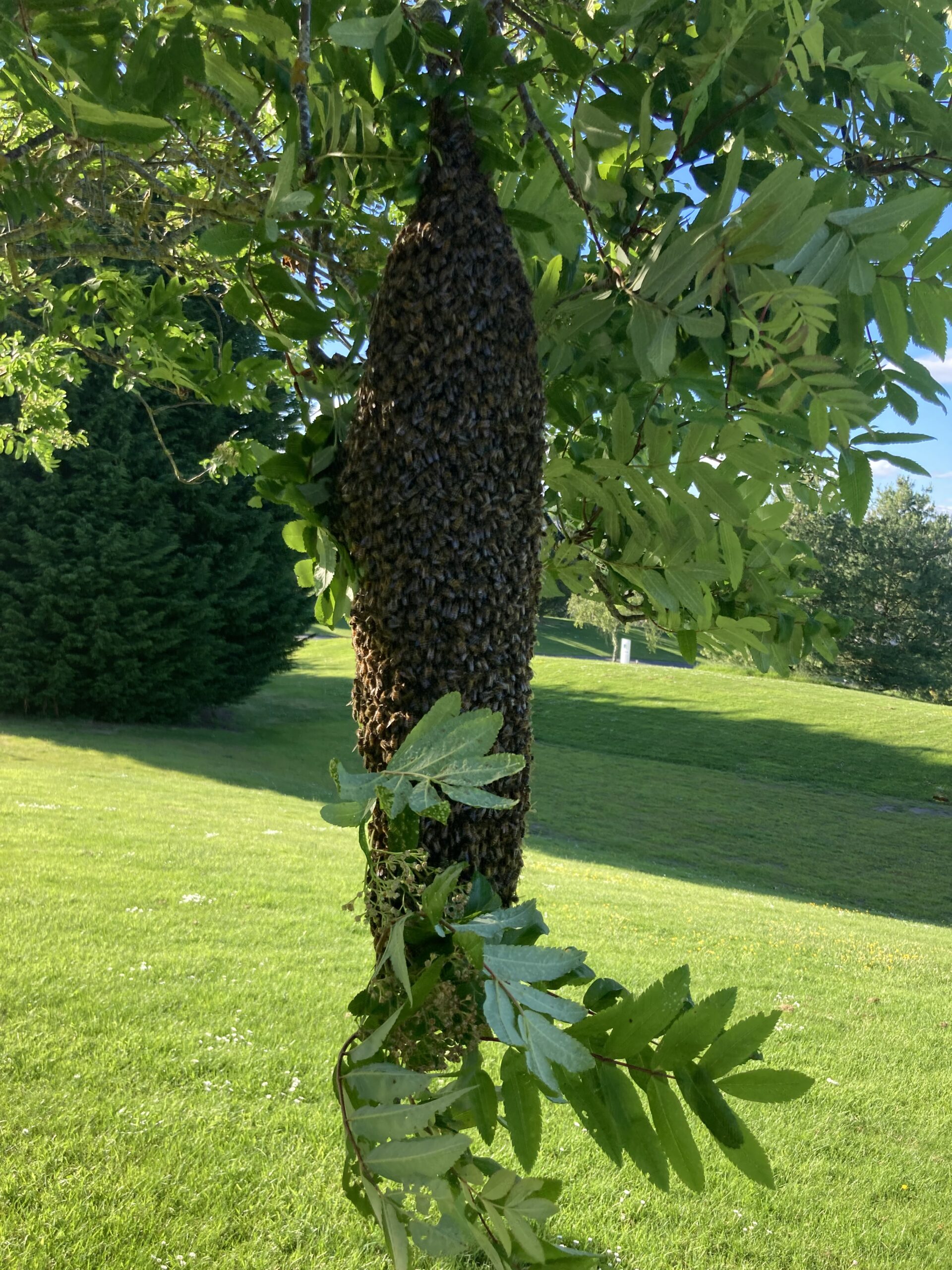

Honey bee swarms consist of thousands of individuals, arrive with a fanfare of noise, before settling down on a branch, fence, wall, car… anywhere really. The average ball of bees is usually around the size of a football, although they can be larger or smaller. The Association has a list of volunteers that can gather and remove honey bee swarms and relocate the bees to a new site. Our volunteers are unable to assist if it is another type of bee or wasps. Unsure if you have honeybees? Have a look at this page to identify the type of bee before contacting the Association. https://www.bbka.org.uk/swarm
If the honey bees have taken up residence in the fabric of a building, that can be more difficult (if not impossible) to be safely dealt with by a beekeeper. Professional pest control personnel will be required to undertake the work either solely or in conjunction with a beekeeper.
Still sure you have a honey bee swarm? Call us on 01738 718371. We have a list of volunteers based in and around Perthshire, who are happy to re-home them.
If the swarm is outside our region, you will need to contact your local association in the area. A list of Scottish beekeeping associations is available here https://scottishbeekeepers.org.uk/about/affiliated-beekeeping-associations